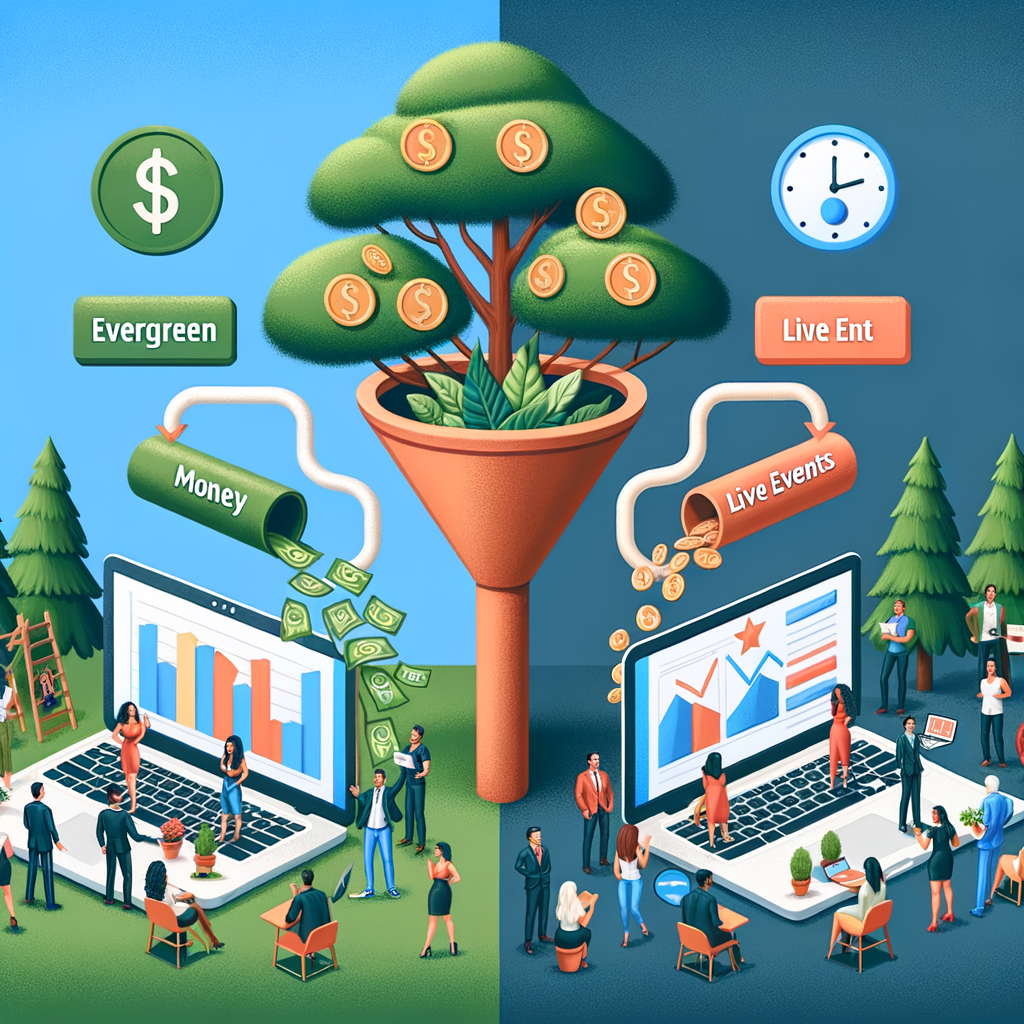
Evergreen funnels vs live events is not really a debate about which model is “better.” It is a question about what stage your coaching business is in, how clear your offer is, and how much feedback you still need from real buyers.
I see coaches get stuck here because they want the machine before they have the message. They want the funnel that runs while they sleep, but they have not yet proven the hook, the promise, the pricing, the objection handling, or the sales conversation. That is why the right answer is usually not “evergreen only” or “live only.” The right answer is sequence.
If you choose the wrong sequence, you can spend months building automation around an offer the market never validated. If you choose the right sequence, live events teach you what buyers respond to, then evergreen funnels help you scale what already works.
The real choice is stage, not theory
A lot of coaches ask whether they should build an evergreen funnel or keep running live events. I think the better question is, what stage are you in?
If you are early, you probably need conversation, feedback, and momentum. Live events give you that. You can teach, watch questions come in, notice where people lean forward, and hear the objections that stop them from buying. That information is gold.
If you already know your offer converts and your audience understands the promise, evergreen can become powerful. It lets people discover your teaching, move through your process, and buy without waiting for your next webinar or challenge. But evergreen works best when it is built from proven material, not guesses.
That is why I like thinking in stages. Use live events to discover the message. Use evergreen to scale the message.
What evergreen funnels do well
An evergreen funnel gives your business consistency. Someone can find your content, join your list, watch a training, receive emails, and buy on their own timeline. That matters when you want your revenue to become less dependent on your calendar.
Evergreen also protects your energy. Instead of relaunching from scratch every month, you can build a system that keeps educating people while you focus on delivery, strategy, content, and sales improvements.
But evergreen is not magic. If the offer is confusing, the funnel will automate confusion. If the sales page does not handle objections, the funnel will send more people to a weak sales page. If the training does not create belief, the automation will not fix that.
Before you build a big evergreen machine, make sure your core sales message is simple enough that a cold prospect can understand it. If your offer needs sharpening, start with how to craft offers that convert before you add more automation.
What live events do well
Live events create urgency, energy, and real-time attention. That can make them stronger for conversion, especially when your message is still evolving.
When you teach live, you get immediate feedback. People ask questions. They tell you what confused them. They reveal the objection behind the objection. They show you which examples land and which parts of the presentation need to be simplified.
That feedback loop is one of the biggest advantages of live events. You are not guessing in a dashboard. You are learning from real humans while the offer is still warm. If you are trying to understand what people want to buy, pair this with how to know what people want to buy from you.
The downside is that live events require energy. You have to promote, show up, teach, sell, follow up, and then do it again. That can work beautifully for a season, but it can also become exhausting if live events are your only revenue engine.
Which model fits each revenue stage
Here is the simple version I would use:
- Early stage: start with live events so you can learn fast.
- Middle stage: add evergreen so revenue becomes more stable.
- Later stage: let evergreen carry the baseline while live events create spikes.
That is not a universal rule. It is a practical coaching-business heuristic. If your audience is tiny and your offer is unproven, live events can help you find the language faster. If your audience is growing and your offer already converts, evergreen can help you multiply what is working.
The mistake is trying to skip the learning phase. You do not want to build a complicated funnel just to avoid the discomfort of selling live. If nervousness around selling is part of the issue, read how to handle getting nervous while selling. Sometimes the business does not need more automation. It needs more reps.
Why the hybrid approach usually wins
The strongest coaching businesses usually use both. Evergreen creates the baseline. Live events create focus, urgency, content, market feedback, and revenue spikes.
A live event can become the source material for your evergreen funnel. The questions people ask can become email follow-ups. The objections can become sales-page sections. The best teaching moments can become ads, blog posts, short videos, and webinar modules.
That is the real leverage. You are not choosing between live and evergreen forever. You are using live to improve the message, then using evergreen to distribute the message more consistently.
If your list is part of that system, protect it. Your email list is one of the assets that makes both live and evergreen work better. That is why your email list is the key to long-term business success.
Build the system, not the scramble
The goal is not to be busy. The goal is to build a repeatable path from attention to trust to sale to transformation.
A live launch without follow-up is a scramble. An evergreen funnel without a proven message is a guess. A content strategy without a next step is noise. But when these pieces work together, your business starts feeling less random.
Start by asking what job each piece is supposed to do. Live events should create energy and feedback. Evergreen should create consistent education and conversion. Email should nurture trust. Content should attract the right people. Your offer should make the next step obvious.
When those pieces align, the decision gets simpler. You are not chasing the trend. You are building the system your stage requires.
What I would recommend today
If your offer is still new, run live events. Teach. Sell. Listen. Improve. Do not hide behind a funnel before you have market clarity.
If your offer is already converting, build evergreen around the best version of your live presentation. Turn your proven teaching into a training, a sequence, a sales page, and a follow-up system.
If you already have both, look for the bottleneck. Are people not opting in? The hook may be weak. Are they watching but not buying? The offer may be unclear. Are they buying but not ascending? The value ladder may need work. This is where the death of the free lead magnet matters, because buyer quality is often more important than lead volume.
Evergreen funnels vs live events is not about picking a side forever. It is about choosing the right tool for the current stage. Learn live. Scale evergreen. Use both on purpose.
About Jeremiah Krakowski
Jeremiah Krakowski is a coaching business mentor who helps coaches, course creators, and consultants scale from $3k/mo to $40k+/mo using direct response marketing, AI systems, and proven frameworks. He runs Wealthy Coach Academy and has 23+ years of experience in digital marketing. Learn more →